For years, Tom Burge did what most livestock farmers on Exmoor have always done: housed his cattle over winter, fed silage and hard feed, and watched the sums add up to little more than survival.
Today, at Oaremead Farm on Exmoor, Tom outwinters his entire herd of Aberdeen Angus cattle on bale grazing and deferred grass, has taken lime, fertiliser and chemical sprays out of the system altogether, and is making significantly more profit per cow than he thought possible, all while watching his soil pH quietly climb back into balance without spending a penny on amendments.
A costly way to keep cows alive
"Between 2015 and 2018 we were housing 80 cows for 150 days over winter. It was costing us £2.09 a cow a day just in feed, and that’s before you add labour, machinery and fuel. When we worked it out afterwards, there was no profit in the system at all. We were just keeping cows alive through winter so we had something to turn out in spring.
‘There was no profit in the system at all; we were just keeping cows alive through winter.’
The first steps out of the shed
"In 2019 we started strip bale grazing to keep the cows out for an extra two months before bringing them in ahead of February calving. That got the wintering cost down to £1.99 a cow a day. It doesn’t sound like much of a saving, but it was the first proof that keeping cows outside for longer was actually cheaper than keeping them in.
"The following year I built my own bale unroller and started unrolling hay rather than just strip grazing whole bales. We were still housing for calving in February through to May turnout, but the system was evolving all the time."
A change of mindset, not just a change of system
"2023 was when it really changed. We sold all 1,200 commercial ewes, stopped housing altogether, and now fully outwinter every cow and R1 heifer, with calving done outside. We don’t use fertiliser, lime, reseed or feed any supplements; we just make hay. It wasn’t a change to one thing, it was a change to the whole mindset behind how we farm."
The results speak for themselves. Wintering costs have fallen to just £0.32 a cow a day, over 85% lower than the 2018 figure, which Tom points out would be worth £3 or more today once inflation is factored in. Fuel use is down 51%, the farm needs 62.5% fewer bales, and labour required for wintering has dropped by 62%.
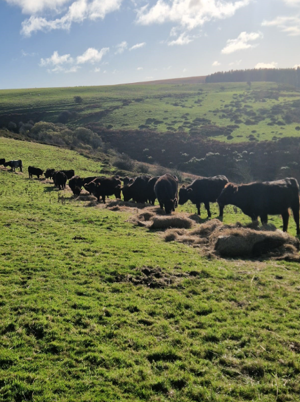 Hay unrolled across deferred grass on the Exmoor hillside for one of the outwintering mobs.
How the system works today
Oaremead Farm runs to 300ha of grassland and 1,770ha of hill and moorland, carrying 150 to 160 Aberdeen Angus breeding cows, calving outdoors from 10th April at two years old, alongside 600 Scotch Blackface ewes. R1 heifers are outwintered with the main herd; only the R1 steers are still wintered in a shed. Cattle are sold store at 12 to 18 months.
"We run the whole farm as an outwintering platform now. We split the herd into three mobs of around 53 cows, plus a mob of R1 heifers, and each mob gets half a hectare of deferred grass a day, with one bale unrolled onto it. If the weather turns rough they might get a second bale, or if I think they need topping up. That works out at roughly ten bales a mob a week, across 100 to 120 days of bale grazing and deferred grass each winter.
"It only takes an hour and a half to two hours of labour a day to look after 230 cattle through the winter. That’s before you even get into the fuel and machinery savings. We also leave a percentage of bales out in the fields, or store them under hay covers, to save on both."
Reading the market, not just the weather
"Normally we sell all our store cattle by 18 months old, at an average weight of 400kg. But this year we sold half the smaller steers at just 12 months, because the market was so strong. It was also about making myself more resilient if we hit another drought situation, and as it turned out, that was a good decision.
"For me it's more about the systems and the profit per head than chasing weight gain. Get that right and the cattle will work for you. Our R1 heifers have to be over 300kg at 14 months before they go to the bull, and I select the most fertile ones to stay in the herd. TB testing every six months is another factor we always have to plan around."
Unrolling the wrong way, on purpose
"We unroll the bales the wrong way round, on purpose. It makes the bale unroll further, which spreads the mob out over a bigger area and stops them poaching one small patch of ground so heavily. Secondly, it spreads any seed left in the bale, which helps introduce new species into the sward."
Rest and Recovery after Pressure
"There’s one field I genuinely thought I’d trashed. After the cattle had been across it, it looked like a mess: poached, muddy, torn up. But it bounced back better than ever, with new species of grass coming through that we hadn’t seen there before. That’s when it really clicked for me how much resilience there is in the system, if you let it work."
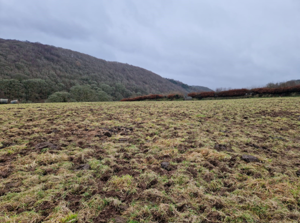
Straight after grazing: the field Tom thought he’d ruined.
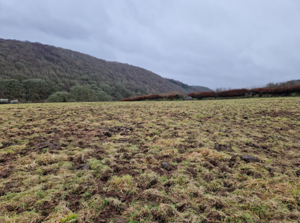
The same field months later, thicker and more diverse than before.
Reading the weather, not the calendar
"The weather plays a huge part in how we graze up here. We get an average of 1,020mm of rain over the winter months alone [1st October to 31st March], on top of about 1,550mm a year across the farm as a whole. I use a winter grazing plan to keep me on track, but it’s constantly changing. On wet, windy days we speed the moves up, sometimes moving twice a day. On cold, dry days we slow right down, giving more hay and smaller breaks. You have to read what’s in front of you, not just follow a plan on paper."
The numbers behind the change
"In 2023 our most profitable enterprise on paper was the 1,200 commercial ewes, making £36,000, plus £9,400 from 94 cows, for £45,400 in total. We sold the commercial ewes and focused everything on the cattle and a smaller, better run flock of hill sheep instead. By 2025 the 160 cows alone were making £650 a head, £104,000 in total, 130% more profit than the old system, from fewer enterprises and less labour.
"We kept 600 hill ewes and gave them more time and focus rather than more numbers. Profit per head on those went from £5 in 2018 to £34.50 in 2025, a 590% increase. Doing less, better, made us more money and gave us more time."
Healthier soil, without the lime bill
Tom’s changes haven’t just shown up in the farm accounts, either. They’re alsovisible in the soil. Much of Oaremead’s ground carries a pH of around 5.5 and ranges from dark peat to deep red clay. Remembering they get over 1,500mm of rain a year, these conditions would once have been considered impossible to outwinter livestock on, let alone build soil health on without regular applications of lime.
Five years of bale grazing and rotating cattle and sheep across the farm proved that it could be done. Tom has eliminated the purchase of lime, fertiliser and chemical sprays altogether. Forage biomass has increased, plant species diversity is increasing and soil pH is rising to a neutral level, all while his herd has grown, despite warnings from others about what would happen if he stopped applying lime and fertiliser.
‘People warned us the system would fall apart without lime and fertiliser. Five years on, we’re carrying more stock, spending less money, and watching the soil get better under our feet, not worse.’
Change the system, change the results
Tom’s figures, summarised in his own “Change the System, Change the Results” graphic below, tell a simple story: lower costs, healthier soil, calmer cattle and a stronger business are built not on spending more, but on spending wiser and managing better.
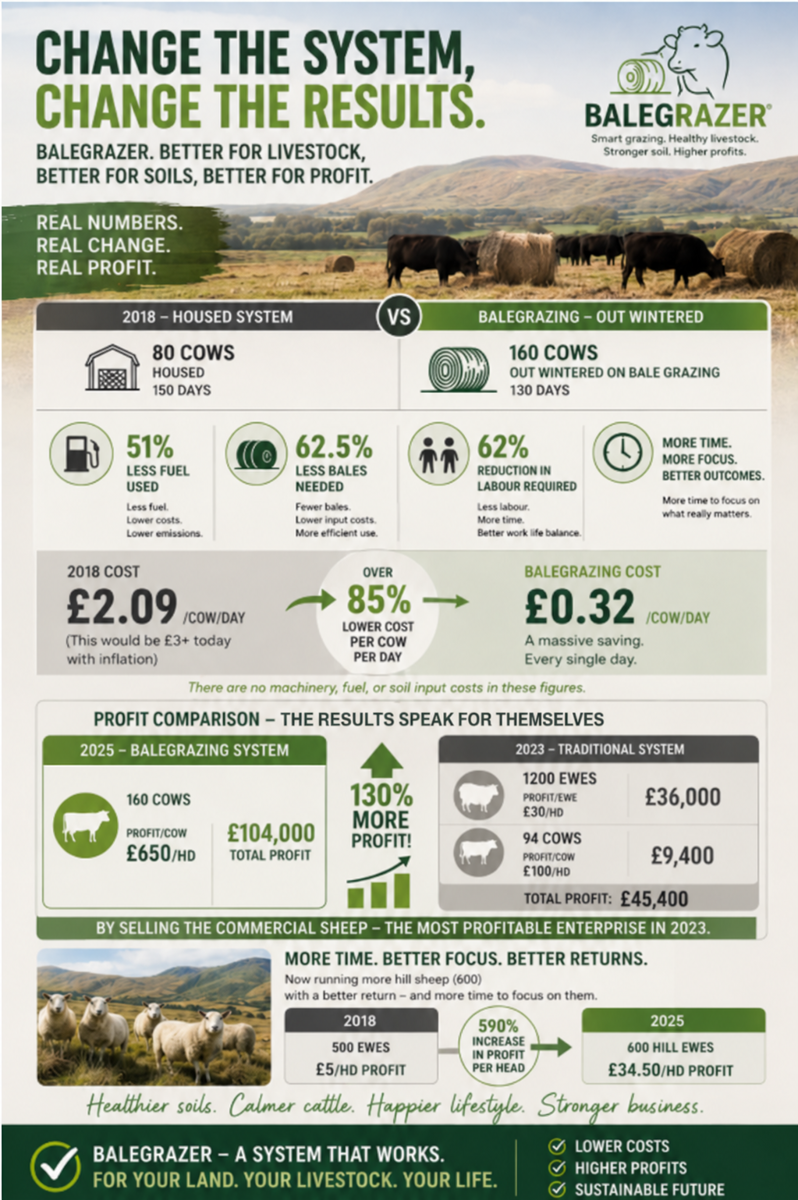
Tom’s summary of the financial results of his transition to bale grazing and outwintering at Oaremead Farm.