Moor Farm is now a 180 Hectare (165Ha effective) holding and has been in the family since 1940. It has grown from an initial 18 Ha farm, added to gradually over generations. Although it has always been a dairy farm it has a rich history of mixed enterprises including beef, cereals and poultry, as well as diversifications into tourism and residential property.
When I returned to the farm after formal education, we made the decision to specialise in dairy production. After initially converting to a spring calving grass-based system it was clear financially this enterprise far outperformed anything else we were doing. The herd went through a period of growth from 120 cows to a peak of 350. Investments were made in infrastructure and milking facilities to accommodate this growth.
Management practice was typical of this production model with high nitrogen fertiliser use and short grazing rotations of monoculture perennial ryegrass leys. Financially the farm did well and technically the farm benchmarked comparably to others of a similar type.
Following a series of personal circumstances, as well as observations of cow behaviour, I started to question the way the farm was managed and how it interacted with its environment. This led to a desire to learn more about how we can produce food in a way that mimics nature.
Several different strategies have been implemented following further reading and educational courses such as holistic management training, soils courses with Nicole Masters (Online Courses – Integrity Soils), Soil Health Academy with Understanding Ag (Understanding Ag - Restoring Soil, Profits, Farms and Futures) and Total grazing course with Jaime Elizondo (Real Wealth Ranching by Jaime Elizondo). Along with a library of books on the various pillars of eco agriculture plus numerous podcasts and YouTube videos.
Below I will break down some of these measures and the impacts witnessed.
Foliar fertiliser
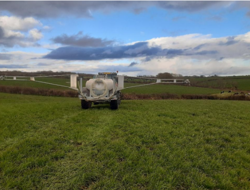
Tow and Fert
This was a primarily financial decision following research that applying nitrogen in the form of Urea to the foliage of the grass plant can elicit the same growth effect with 40% less than soil applied fertiliser. To facilitate this, we imported a Tow & Fert from New Zealand which also gives the ability to apply fine particle fertilisers in suspension and create bespoke fertiliser mixes. In the table below it can be observed that we obtained a 63% reduction in chemical N per Ha and maintained grass productivity.
2019 | 2020 | 2021 | |
Milking Platform Kg/N/Ha (range) | 220 (190-280) | 160 (125-190) | 82 (25-112) |
Pasture utilised t DM/Ha | 11.6 | 10.9 | 12 |
MS Production Kg | 132700 | 147000 | 166600 |
S.R. (all farm)/Ha | 2.5 | 2.76 | 2.93 |
Purchased Feed £/LSU | 372 | 368 | 387 |
We can now think more about soil and plant nutrition adding bio stimulants and trace elements to make the forage as complete as possible. Further positive outcomes have been reduced mastitis rates and improved herd breeding statistics. Annual mastitis rates now run at 3-5 % and empty rates are less than 8% on a 9-week breeding window. Cows are also noticeably more content when grazing.
Mixed species leys
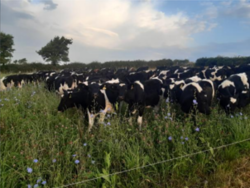
Grazing mixed ley in late summer
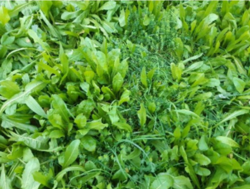
Mixed species leys
Mixed species leys or herbal leys are swards with a mixed composition of plants. Having started experimenting with half paddock trials against ryegrass/ white clover swards in 2018, about half the paddocks on the farm now have at least 4 different species of productive forage plants within. The range of rooting depths bring different mineral profiles into the forage as well as providing additional resilience to climate fluctuations. The differing growth profiles even out forage production through the year meaning less peaks and troughs.
Plantings now typically contain ryegrass, cocksfoot, tall fescue, timothy, red clover, white clover, plantain and chicory. When sown we will also often include annual plants such as oats, vetch and linseed to bring additional forage in year 1 and help recolonise mycorrhizal fungal populations.
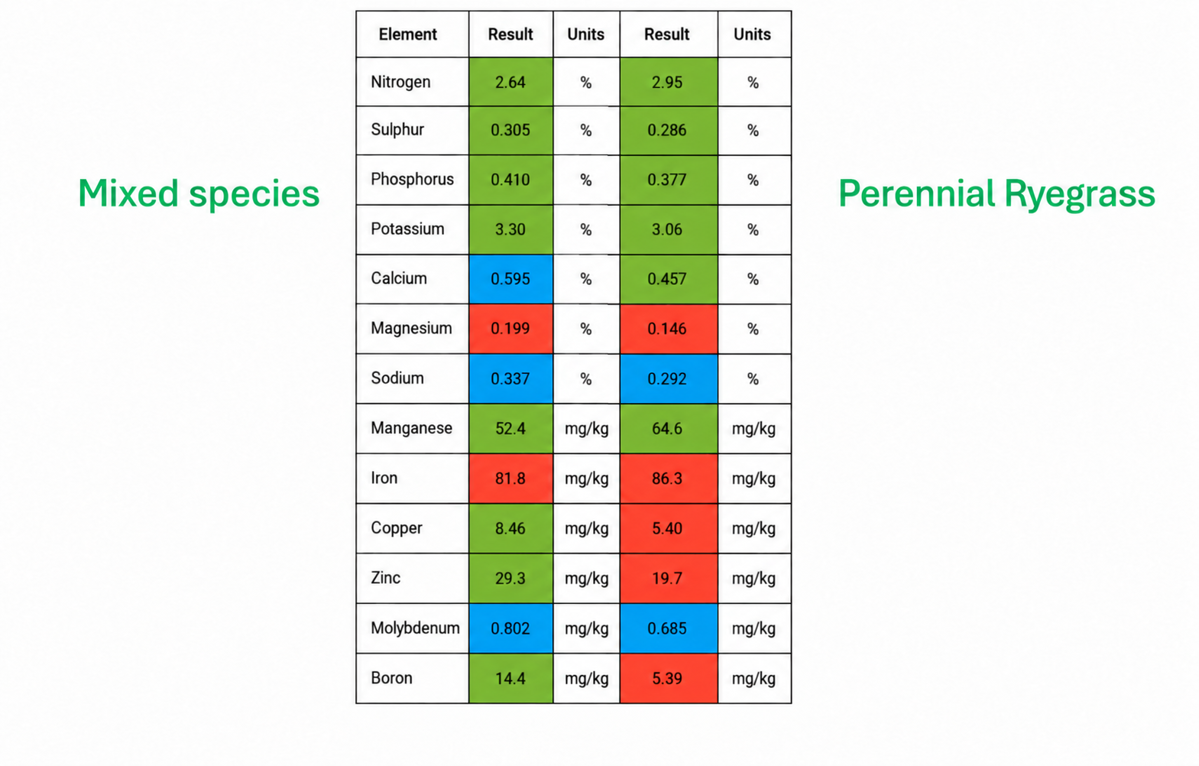 Plant tissue analysis
These swards require differing management from ryegrass leys. Short grazing durations and longer rest periods to avoid overgrazing plants. The challenge is to pick the right indicator species within the mix to dictate the correct rest period. For our farm this is typically Cocksfoot at the 3-4 leaf stage. At this stage the plant has recovered from the previous grazing event, indicated by all the leaves being pointed rather than the blunt end of a grazed leaf. It is also maximising the plant's ability to capture sunlight before entering its reproductive phase. As soil and plant health improves I expect this to increase to 4-5 leaves, thus giving more opportunity to capture sunlight before defoliation.
Soil structure under mixed species swards is visually better in aggregation. It is also obvious how much more insect life is found in these paddocks and subsequently bird life.
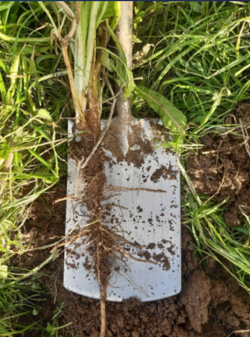
Root architecture
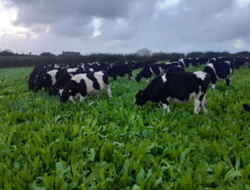
Grazing new mixed species ley
Multispecies cover crops
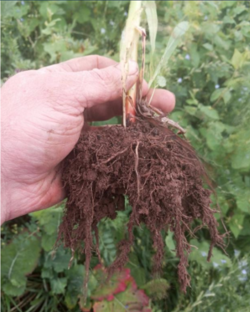
Rhizosheath
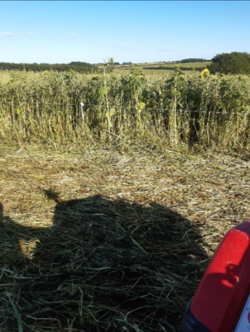
Gabe Brown in the US and Jono Frew in New Zealand, highlight the importance of plant diversity. This supports an increased diversity of soil biology. Jono Frew promoted the idea of a soil reboot, taking monoculture pasture and sowing a broadly diverse, mainly annual plant mixture. The aim is to have plants from as many plant families as possible. The perennial clovers and herbs remain afterwards, and perennial grasses drilled in.
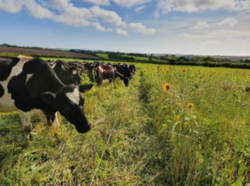
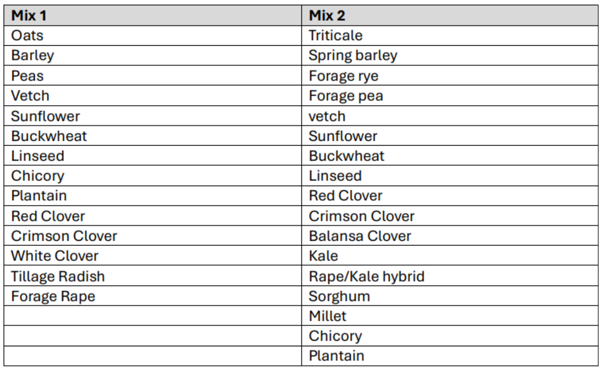
We have planted a summer cover crop mix in 2 different summers and have tried different species with varying degrees of success. The 2 mixes are set out in the table below. Both times the mixes where grazed at least 90 days after planting to allow as much time for plant expression and root exudation. This did mean the plants where perhaps not as vegetative for milk production, but improved soil fertility. It was managed as a 2 hour break each day to allow the grazing rotation to be extended on the rest of the farm. This meant little change in milk volume production but an increase in butterfats.
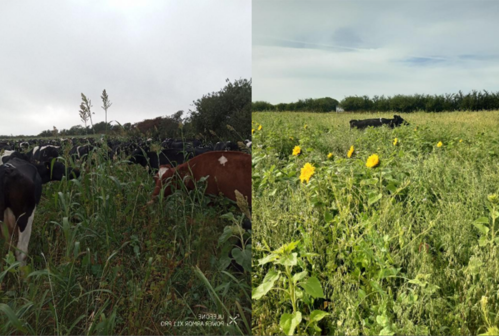
Due to the amount of residue laid on the surface, seeded back to perennials after proved difficult, however the seed drop from the mix allowed for regeneration and regrowth provided to further grazing into winter allowing perennials to be established the following spring.
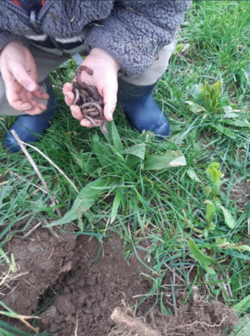
The visual soil improvements following where obvious in its aggregation and earthworm counts of 30-40 worms per spade square. Soil analysis showed increases in plant available nutrients with no additions made
Grazing Management
Grazing management is key to the success of a grass based dairy system. Ensuring paddocks are grazed at the correct time to strike the balance of optimal production and quality. As mentioned above the use of more diverse swards has required a change in management to perennial ryegrass swards. The goal in mimicking nature is a short grazing period followed by a period of rest, as the migrating herds of the past continually being moved by predators. The role of the grazing manager is to then also manage the supply of grass that there is always feed available coupled with allowed periodic regeneration of swards. To help manage this complexity we use planned grazing methods and charts as promoted by Allan Savory.
To know when grass is at it's optimum to graze during the main growing season we use indicator species to determine that the sward has sufficiently recovered while still maintaining quality. This is typically 3-4 leaves on Cocksfoot or 2.5-3 leaves on ryegrass. As soil improves it should be possible to increase this as the plant is able to support more growth before moving into a reproductive phase.
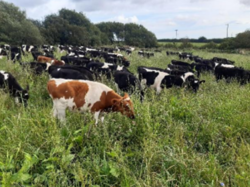
Summer grazing
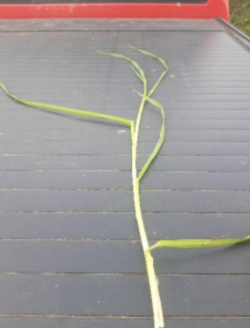
Recovered cocksfoot tiller
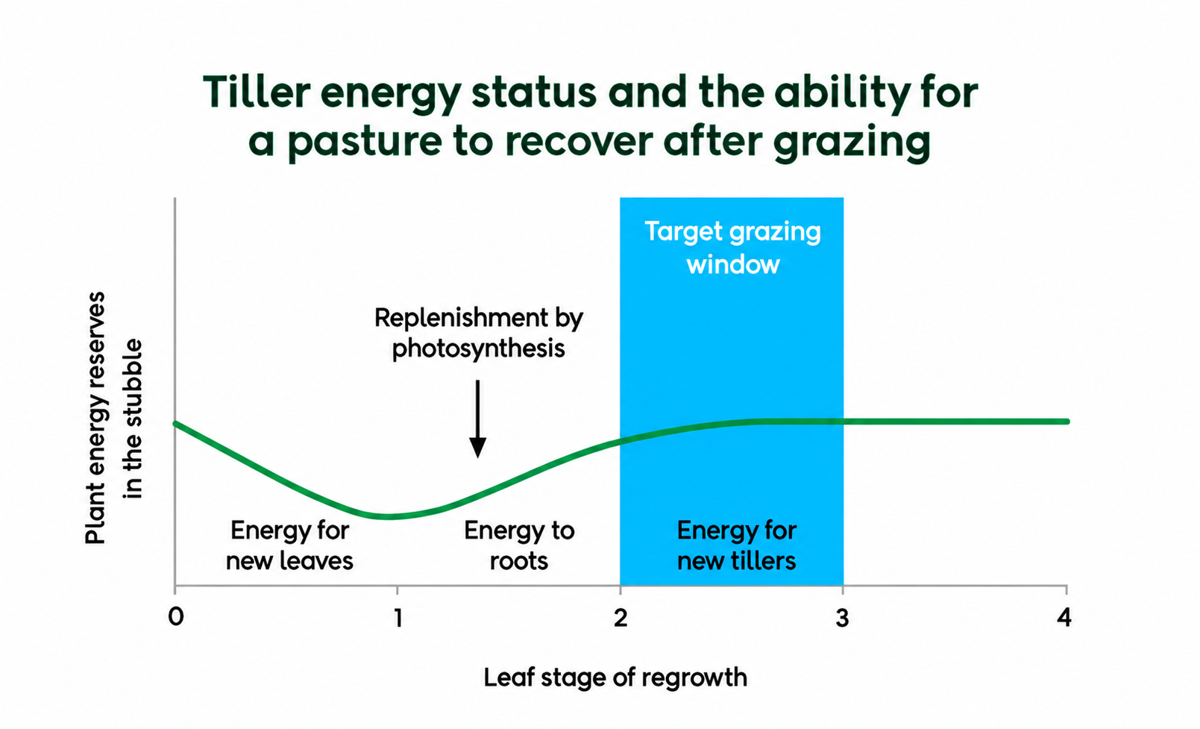
Plant recovery of energy reserves (perennial ryegrass)
Historically when grass growth exceeded supply, silage would be made for later in the season. Although this is still a management practice, we now also make use of deferred grazing, that is the grass is allowed to continue growing and often set to seed. This method of “storing” feed in the paddock removes the expenses of making conserved fodder such as pit silage or bales. This extended period of rest allows roots to fully recover and grow deeper, exudating more complex carbon compounds to build soil humus. The setting of seed allows for a natural regeneration removing the need to buy seed and cultivate.
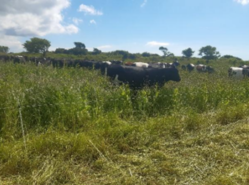
Grazing a deferred paddock
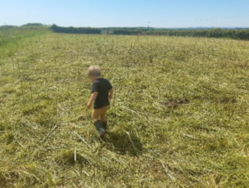
Post grazing residual
It is important to monitor livestock gut fill and body condition when on lower quality pasture to ensure growth targets are still met. In addition to deferring grass we make use of bale grazing, this places bales in the pasture prior to winter to graze in situ. These bales can be either made much earlier in the season from the same paddock and so nutrient is cycled back to where it came from or from imported forage to add fertility.
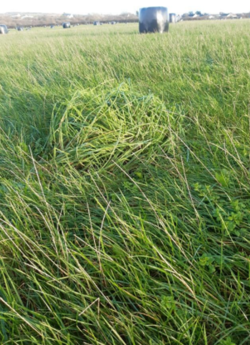
Bales placed ready for winter
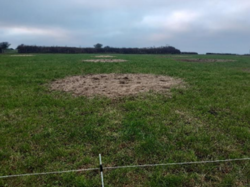
Bale grazed paddock in early spring
Conclusions
It is important for anyone considering implementing regenerative farming practises that there is no one correct answer. It depends on the context of the farm and individual. It is recognised as a set of 6 principles to farm in harmony with nature and improve our natural resource.
These 6 principles are:
Know your context.
Minimise disturbance, both mechanical and chemical.
Cover and build surface armour.
Diversity – A large array of insects, plants, microbes and animals. No monocultures in nature.
A living root for as much of the year as possible.
Animal integration – grow healthy animals and soil together.
For our own farm we have tried many different things, and this case study is a small snapshot of those. Farmers should not be afraid to try new things but do so in a controlled manner. This includes using safe to fail studies on small areas when first implementing new practises. The first challenge is to change the way you see things, mindset change has more impact than the practices carried out.
The farm is financially more resilient under this management practice as we are less reliant on external inputs. Although other decisions on farm have meant our production has been lower in the last 2 years, such as milking once a day, I am confident we can produce as much as we have under conventional practices with less of an environmental impact and more nutrient dense produce.